
It’s a conversation that keeps surfacing with clients and peers alike. Teams are overwhelmed, budgets are stretched, and yet marketing feels harder than ever.
Not because they lack tools, but because they’ve invested in too many.
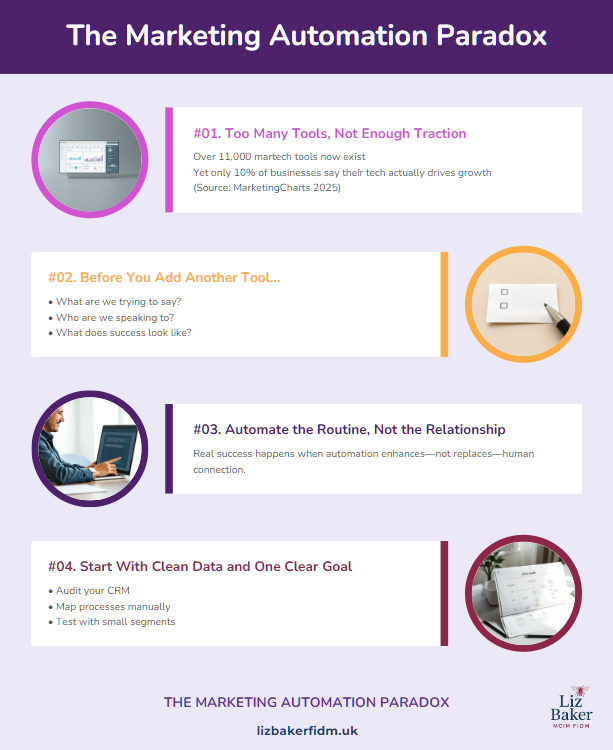
Despite the martech landscape now containing over 11,000 platforms (WebFX, 2023), many businesses are still seeing minimal returns. The idea that ‘more tools = better results’ simply doesn’t hold up.
More Tech, Less Traction
I was brought in to audit a firm’s marketing stack. Over the previous two years, they’d accumulated seven automation tools.
Individually, they were solid. Collectively, they were chaos. The platforms didn’t integrate well. Data lived in silos. Manual workarounds filled the gaps, and the team spent more time managing the tech than executing strategy.
It’s not an unusual situation. In a survey by MarketingCharts, they reported that more than 4 in 10 businesses describe acquiring qualified leads as a ‘mission critical’ objective. Yet only 10% strongly agree their current tech stack actually supports their demand generation goals.
That gap is telling. It isn’t a failure of technology, it’s a failure to approach automation strategically.
Ask the Right Questions First
Before you consider adding another tool, pause and reflect. Three questions I ask clients again and again:
- What are we trying to say?
Clear messaging trumps clever tech. If your value proposition is muddled, automation will only amplify the confusion. - Who exactly are we speaking to?
Without proper segmentation, automation becomes noise. The most successful campaigns I’ve delivered started with customer persona work, not platform demos. - How will we measure success?
Don’t confuse open rates with impact. Decide which business outcomes matter and ensure your automation is driving those—consistently and measurably.

Let People Lead the Process
Even with the surge in AI, a welcome shift is underway. Businesses are moving towards human-centred automation. Not less technology, but smarter implementation.
When I map customer journeys for clients, we don’t start with tools. I start by identifying where real human interaction adds value. Automation then supports the handover, streamlining routine tasks so teams can focus on building relationships.

Start Small, Win Big
Over the years, I’ve helped organisations streamline convoluted systems into lean, effective automation that works.My approach? Always start with a ‘minimum viable automation’ mindset:
- Choose one clear outcome. Whether it’s onboarding, nurturing or reactivating, focus on doing one process well.
- Map it manually first. If it can’t be done on paper, it can’t be automated effectively.
- Pilot with a small group. Use real feedback from a focused audience before scaling across your database.
Fix the Foundations First
There’s one overlooked truth about automation: it’s only as good as your data. Your tech can’t succeed on top of messy records or outdated contact fields.
Start with a CRM audit. Check for consistency, duplication, and completeness. Set standards. Build habits. Keep your data clean. It’s not glamorous, but it’s what makes the rest work.
Final Thoughts - Automation That Feels Seamless
Looking ahead, the brands that thrive won’t be the ones with the longest martech list—they’ll be the ones with the clearest marketing strategy. They’ll build stacks that integrate, not just accumulate. They’ll automate with purpose, not panic.
The question isn’t “Should we use automation?” It’s “Are we making things easier or harder for our customers?”
As I always say, you should automate the heck out of everything you can so that you can focus on the weird stuff when it turns up.
Because if your automation isn’t helping them navigate your world more smoothly, it’s time to go back to the drawing board.
#MarketingStrategy #MarketingAutomation #CustomerJourney